

Whole-home softening and filtration, plus reverse-osmosis drinking water, installed by a professional installer. Your water is not the same as the next city over, so we start by reading what your utility actually publishes for your address.
Every utility here publishes a water quality report. They do not all say the same thing, and the differences are bigger than most homeowners expect. These are the three that change what a system needs to do.
Cedar Park draws from Lake Travis and delivers treated water at 183 ppm total hardness, about 10.7 grains per gallon. Austin Water delivers about 93 ppm, roughly 5.4 grains, because it runs a lime softening process at the plant. Same region, very different scale and spotting on fixtures, glassware and shower doors.
Round Rock blends surface water from Lake Georgetown with Edwards Aquifer groundwater. In 2024, delivered hardness ranged from 184 to 358 ppm, roughly 11 to 21 grains per gallon, depending on the blend reaching a given part of the system. That is why we read your address rather than a regional average.
Austin Water, Cedar Park and Round Rock all disinfect with chloramine rather than free chlorine. Reported distribution system averages are 2.3 ppm in Austin, 3.09 ppm in Cedar Park and 1.99 ppm in Round Rock. Chloramine behaves differently from free chlorine at the carbon stage, which changes how that stage gets sized.
The same four stages do the work in every home. What changes between an Austin address and a Cedar Park one is how they are sized.
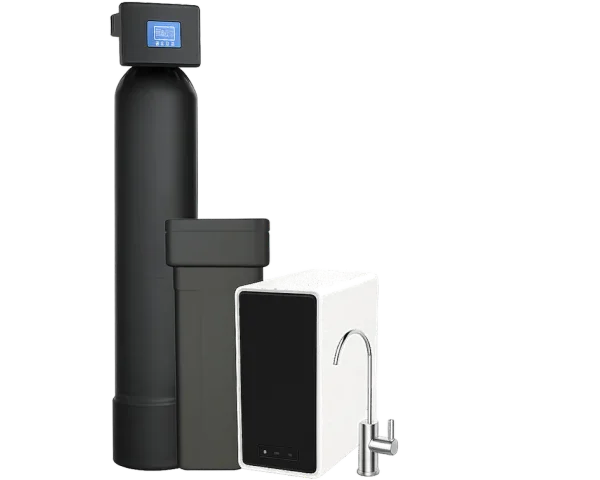
Your complete bundle
Whole-home softening & filtration tank, brine tank, and under-sink reverse osmosis with a dedicated faucet.
Handles chloramine and treatment by-products at the inlet, which is what changes taste and odor throughout the house.
Removes the hardness minerals that leave scale and spotting on fixtures, glassware and shower doors.
The part that runs the regeneration cycle and decides when the softening stage cleans itself.
Holds the media layers under line pressure. Sizing it correctly is what keeps flow steady when several fixtures run at once.
Tell us your address. We pull the published water quality report for your utility and send you what it says about your supply.
We walk through the report together, tell you which parts of it a system would actually change, and give you the all-in installed figure.
A professional installer sets up your system.
We're local. Christian is based in Cedar Park, and every install is in our backyard, across Greater Austin.
We read the published report for your utility before recommending anything. You see what it says and what a system would actually change.
Christian holds a Construction Science degree from Texas A&M and works in residential home building. That background is how these installs get planned.
A professional installer connects the system at your main line, and you approve any change to the figure before work starts.
It depends on what your water actually needs, so we do not post a single number. We start with a free water assessment for your address, then give you the all-in installed figure on one call. Flexible financing available, no credit check.
We pull the published water quality report for your utility, walk you through what it says about your address, and tell you which parts of it a system would actually change.
Yes. Austin Water delivers about 93 ppm total hardness, roughly 5.4 grains per gallon, because it runs a lime softening process at the plant. Cedar Park delivers 183 ppm, about 10.7 grains. Round Rock ranged from 184 to 358 ppm in 2024 depending on the blend of Lake Georgetown surface water and Edwards Aquifer groundwater reaching that part of the system.
Greater Austin, TX: Austin, Cedar Park, Leander, Round Rock, Georgetown, Pflugerville, Lakeway and Hutto. If you're nearby and don't see your city, call us, we likely still cover you.
Tell us your address and we'll send you what your utility publishes about your supply, plus an honest, all-in figure if you want one.